what is 3 482 to two significant figures
Significant figures (also known equally the significant digits, precision or resolution) of a number in positional note are digits in the number that are reliable and necessary to signal the quantity of something.
If a number expressing the effect of a measurement (e.m., length, pressure, volume, or mass) has more than digits than the number of digits immune by the measurement resolution, then only as many digits as allowed past the measurement resolution are reliable, and and then simply these can be significant figures.
For example, if a length measurement gives 114.8 mm while the smallest interval between marks on the ruler used in the measurement is 1 mm, and then the first three digits (one, 1, and 4, showing 114 mm) are certain and so they are pregnant figures. Digits which are uncertain but reliable are too considered significant figures. In this example, the concluding digit (8, which adds 0.8 mm) is too considered a significant effigy even though there is uncertainty in it.[1]
Another example is a book measurement of 2.98 L with an doubt of ± 0.05 L. The bodily book is somewhere between 2.93 L and 3.03 L. Even when some of the digits are not certain, as long as they are reliable, they are considered meaning because they indicate the actual volume within the acceptable degree of incertitude. In this example the actual volume might exist 2.94 L or might instead be iii.02 L. And then all three are significant figures.[2]
The following digits are not significant figures.[3]
- All leading zeros. For example, 013 kg has two meaning figures, one and 3, and the leading zero is non significant since it is not necessary to indicate the mass; 013 kg = 13 kg so 0 is non necessary. In the example of 0.056 m there are two insignificant leading zeros since 0.056 1000 = 56 mm and so the leading zeros are not necessary to indicate the length.
- Trailing zeros when they are simply placeholders. For example, the trailing zeros in 1500 m as a length measurement are not significant if they are merely placeholders for ones and tens places as the measurement resolution is 100 chiliad. In this instance, 1500 m means the length to mensurate is shut to 1500 m rather than proverb that the length is exactly 1500 one thousand.
- Spurious digits, introduced by calculations resulting in a number with a greater precision than the precision of the used data in the calculations, or in a measurement reported to a greater precision than the measurement resolution.
Of the significant figures in a number, the most significant is the digit with the highest exponent value (only the left-most significant figure), and the to the lowest degree pregnant is the digit with the lowest exponent value (simply the right-virtually meaning figure). For case, in the number "123", the "1" is the most significant figure as information technology counts hundreds (ten2), and "3" is the to the lowest degree significant figure as it counts ones (ten0).
Significance arithmetic is a set of approximate rules for roughly maintaining significance throughout a computation. The more sophisticated scientific rules are known as propagation of dubiety.
Numbers are often rounded to avoid reporting insignificant figures. For example, it would create false precision to express a measurement as 12.34525 kg if the scale was only measured to the nearest gram. In this case, the significant figures are the first 5 digits from the left-virtually digit (ane, ii, 3, 4, and v), and the number needs to be rounded to the significant figures so that it will exist 12.345 kg as the reliable value. Numbers tin can also be rounded merely for simplicity rather than to bespeak a precision of measurement, for case, in gild to make the numbers faster to pronounce in news broadcasts.
Radix 10 (base-10, decimal numbers) is assumed in the post-obit.
Identifying significant figures [edit]
Rules to identify significant figures in a number [edit]

Digits in light blue are significant figures; those in blackness are not.
Note that identifying the meaning figures in a number requires knowing which digits are reliable (e.g., by knowing the measurement or reporting resolution with which the number is obtained or candy) since only reliable digits can be significant; eastward.g., 3 and 4 in 0.00234 g are not significant if the measurable smallest weight is 0.001 g.[4]
- Not-zero digits within the given measurement or reporting resolution are significant.
- 91 has two significant figures (nine and 1) if they are measurement-allowed digits.
- 123.45 has five significant digits (1, 2, 3, four and 5) if they are inside the measurement resolution. If the resolution is 0.1, so the last digit five is non significant.
- Zeros between two pregnant non-aught digits are significant (significant trapped zeros) .
- 101.12003 consists of eight significant figures if the resolution is to 0.00001.
- 125.340006 has vii meaning figures if the resolution is to 0.0001: ane, ii, 5, three, 4, 0, and 0.
- Zeros to the left of the starting time non-cypher digit (leading zeros) are not pregnant.
- If a length measurement gives 0.052 km, and so 0.052 km = 52 grand so five and 2 are only significant; the leading zeros announced or disappear, depending on which unit of measurement is used, so they are not necessary to betoken the measurement scale.
- 0.00034 has iv significant zeros if the resolution is 0.001. (3 and 4 are beyond the resolution so are not significant.)
- Zeros to the right of the last non-nix digit (trailing zeros) in a number with the decimal point are significant if they are within the measurement or reporting resolution.
- 1.200 has four significant figures (ane, 2, 0, and 0) if they are allowed by the measurement resolution.
- 0.0980 has three significant digits (ix, viii, and the last zero) if they are inside the measurement resolution.
- 120.000 consists of half-dozen significant figures (1, two, and the iv subsequent zeroes) except for the last zero If the resolution is to 0.01.
- Abaft zeros in an integer may or may non be significant, depending on the measurement or reporting resolution.
- 45,600 has 3, 4 or 5 significant figures depending on how the last zeros are used. For example, if the length of a road is reported equally 45600 1000 without information about the reporting or measurement resolution, so it is non clear if the road length is precisely measured as 45600 1000 or if information technology is a crude estimate. If it is the rough estimation, so only the first iii non-cypher digits are meaning since the abaft zeros are neither reliable nor necessary; 45600 m can be expressed every bit 45.half dozen km or equally iv.56 × ten4 m in scientific notation, and neither expression requires the trailing zeros.
- An exact number has an infinite number of significant figures.
- If the number of apples in a bag is 4 (exact number), then this number is 4.0000... (with infinite trailing zeros to the right of the decimal bespeak). Equally a upshot, 4 does not impact the number of meaning figures or digits in the result of calculations with it.
- A mathematical or physical abiding has significant figures to its known digits.
- π, as the ratio of the circumference to the bore of a circle, is 3.14159265358979323... known to l trillion digits[5] calculated as of 2020-01-29, and that calculated 'π' approximation has that many significant digits, while in practical applications far fewer are used (and π itself has infinite significant digits, every bit all irrational numbers do). Often 3.14 is used in numerical calculations, i.e. 3 meaning decimal digits, with seven correct binary digits (while the more accurate 22/seven is also used, even though it besides only amounts to the same 3 pregnant correct decimal digits, it has 10 right binary digits), which is a skilful enough approximation for many practical uses. Most calculators, and computer programs, can handle 3.141592653589793, 16 decimal digits, that is ordinarily used in computers and used past NASA for "JPL's highest accuracy calculations, which are for interplanetary navigation".[6] For "the largest size at that place is: the visible universe [..] yous would need 39 or forty decimal places."[6]
- The Planck constant is and is defined as an exact value and so that it is more properly defined as .[7]


Ways to denote meaning figures in an integer with abaft zeros [edit]
The significance of trailing zeros in a number not containing a decimal point tin can be cryptic. For instance, it may not always be clear if the number 1300 is precise to the nearest unit (only happens coincidentally to be an exact multiple of a hundred) or if it is only shown to the nearest hundreds due to rounding or uncertainty. Many conventions exist to address this outcome. Even so, these are non universally used and would only be constructive if the reader is familiar with the convention:
-
- An overline, sometimes also chosen an overbar, or less accurately, a vinculum, may be placed over the last meaning figure; any trailing zeros post-obit this are insignificant. For case, thirteen00 has three significant figures (and hence indicates that the number is precise to the nearest ten).
-
- Less often, using a closely related convention, the last pregnant effigy of a number may be underlined; for example, "one300" has two significant figures.
-
- A decimal point may be placed afterwards the number; for example "1300." indicates specifically that trailing zeros are meant to be significant.[8]
As the conventions to a higher place are non in full general utilise, the following more than widely recognized options are bachelor for indicating the significance of number with trailing zeros:
-
- Eliminate ambiguous or not-significant zeros by changing the unit prefix in a number with a unit of measurement. For instance, the precision of measurement specified as 1300 k is ambiguous, while if stated equally 1.30 kg it is non. As well 0.0123 Fifty can be rewritten as 12.three mL
-
- Eliminate ambiguous or non-significant zeros by using Scientific Notation: For example, 1300 with three significant figures becomes ane.30×tenthree . Likewise 0.0123 can be rewritten as one.23×x−2 . The part of the representation that contains the meaning figures (1.thirty or 1.23) is known equally the significand or mantissa. The digits in the base and exponent ( 103 or 10−two ) are considered verbal numbers so for these digits, significant figures are irrelevant.
-
- Explicitly state the number of pregnant figures (the abbreviation s.f. is sometimes used): For example "20 000 to 2 s.f." or "20 000 (2 sf)".
-
- State the expected variability (precision) explicitly with a plus–minus sign, equally in xx 000 ± 1%. This too allows specifying a range of precision in-between powers of ten.
Rounding to meaning figures [edit]
Rounding to significant figures is a more general-purpose technique than rounding to northward digits, since it handles numbers of unlike scales in a uniform way. For example, the population of a city might only be known to the nearest thousand and exist stated as 52,000, while the population of a state might simply be known to the nearest meg and be stated every bit 52,000,000. The onetime might be in error by hundreds, and the latter might be in error by hundreds of thousands, but both take 2 significant figures (v and ii). This reflects the fact that the significance of the error is the same in both cases, relative to the size of the quantity existence measured.
To round a number to due north significant figures:[ix] [10]
- If the n + 1 digit is greater than 5 or is v followed past other not-zip digits, add one to the northward digit. For instance, if we desire to round 1.2459 to 3 significant figures, and then this step results in ane.25.
- If the n + ane digit is five not followed by other digits or followed by only zeros, then rounding requires a tie-breaking rule. For case, to round 1.25 to 2 meaning figures:
- Round one-half away from naught (also known as "5/4")[ citation needed ] rounds upward to 1.iii. This is the default rounding method implied in many disciplines[ commendation needed ] if the required rounding method is non specified.
- Round half to even, which rounds to the nearest even number. With this method, 1.25 is rounded downward to 1.ii. If this method applies to one.35, then it is rounded up to ane.4. This is the method preferred by many scientific disciplines, because, for example, it avoids skewing the average value of a long list of values upwards.
- For an integer in rounding, supercede the digits later the due north digit with zeros. For example, if 1254 is rounded to two significant figures, then 5 and 4 are replaced to 0 so that it will be 1300. For a number with the decimal point in rounding, remove the digits afterward the north digit. For example, if xiv.895 is rounded to 3 meaning figures, then the digits after eight are removed so that it will be 14.ix.
In financial calculations, a number is frequently rounded to a given number of places. For case, to two places later the decimal separator for many earth currencies. This is done because greater precision is immaterial, and commonly information technology is non possible to settle a debt of less than the smallest currency unit.
In Great britain personal revenue enhancement returns, income is rounded downwards to the nearest pound, whilst revenue enhancement paid is calculated to the nearest penny.
As an illustration, the decimal quantity 12.345 can be expressed with various numbers of significant figures or decimal places. If bereft precision is available so the number is rounded in some manner to fit the available precision. The post-obit table shows the results for various total precision at ii rounding means (Due north/A stands for Non Applicable).
| Precision | Rounded to significant figures | Rounded to decimal places |
|---|---|---|
| six | 12.3450 | 12.345000 |
| 5 | 12.345 | 12.34500 |
| 4 | 12.34 or 12.35 | 12.3450 |
| 3 | 12.3 | 12.345 |
| ii | 12 | 12.34 or 12.35 |
| 1 | x | 12.3 |
| 0 | N/A | 12 |
Another case for 0.012345. (Remember that the leading zeros are not significant.)
| Precision | Rounded to pregnant figures | Rounded to decimal places |
|---|---|---|
| vii | 0.01234500 | 0.0123450 |
| six | 0.0123450 | 0.012345 |
| 5 | 0.012345 | 0.01234 or 0.01235 |
| 4 | 0.01234 or 0.01235 | 0.0123 |
| three | 0.0123 | 0.012 |
| 2 | 0.012 | 0.01 |
| i | 0.01 | 0.0 |
| 0 | N/A | 0 |
The representation of a non-zippo number ten to a precision of p pregnant digits has a numerical value that is given past the formula:[ commendation needed ]
- where
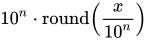

which may demand to be written with a specific mark equally detailed above to specify the number of significant trailing zeros.
Writing uncertainty and unsaid uncertainty [edit]
Significant figures in writing uncertainty [edit]
It is recommended for a measurement outcome to include the measurement uncertainty such as , where tenbest and σ10 are the all-time guess and dubiety in the measurement respectively.[11] xbest can be the average of measured values and σten can be the standard deviation or a multiple of the measurement divergence. The rules to write are:[12]

- σx has only 1 or two significant figures equally more precise uncertainty has no meaning.
- 1.79 ± 0.06 (correct), 1.79 ± 0.96 (correct), 1.79 ± 1.96 (incorrect).
- The digit positions of the concluding significant figures in 10best and σ10 are the same, otherwise the consistency is lost. For example, in 1.79 ± 0.067 (incorrect), it does non brand sense to have more accurate uncertainty than the all-time estimate. one.79 ± 0.9 (incorrect) also does not make sense since the rounding guideline for add-on and subtraction below tells that the edges of the true value range are ii.vii and 0.nine, that are less accurate than the best estimate.
- one.79 ± 0.06 (correct), 1.79 ± 0.96 (correct), one.79 ± 0.067 (incorrect), 1.79 ± 0.9 (incorrect).
Unsaid uncertainty [edit]
In chemistry (and may also exist for other scientific branches), incertitude may be unsaid past the last meaning figure if it is non explicitly expressed.[2] The implied uncertainty is ± the one-half of the minimum calibration at the last pregnant figure position. For case, if the volume of water in a bottle is reported equally 3.78 L without mentioning doubt, so ± 0.005 L measurement uncertainty may be unsaid. If two.97 ± 0.07 kg, so the actual weight is somewhere in 2.90 to 3.04 kg, is measured and it is desired to written report it with a single number, then iii.0 kg is the all-time number to report since its implied incertitude ± 0.05 kg tells the weight range of two.95 to 3.05 kg that is shut to the measurement range. If 2.97 ± 0.09 kg, and so iii.0 kg is still the all-time since, if 3 kg is reported and then its unsaid uncertainty ± 0.v tells the range of 2.v to 3.v kg that is too wide in comparing with the measurement range.
If there is a need to write the implied incertitude of a number, then it tin can exist written as with stating it as the unsaid doubtfulness (to prevent readers from recognizing it as the measurement uncertainty), where x and σx are the number with an extra cypher digit (to follow the rules to write doubtfulness above) and the implied uncertainty of it respectively. For example, 6 kg with the implied doubtfulness ± 0.five kg tin be stated as six.0 ± 0.five kg.

Arithmetic [edit]
As at that place are rules to determine the meaning figures in direct measured quantities, there are too guidelines (not rules) to determine the pregnant figures in quantities calculated from these measured quantities.
Pregnant figures in measured quantities are almost important in the determination of significant figures in calculated quantities with them. A mathematical or physical constant (e.one thousand., π in the formula for the expanse of a circle with radius r every bit πr 2 ) has no effect on the determination of the significant figures in the result of a calculation with it if its known digits are equal to or more than the meaning figures in the measured quantities used in the calculation. An verbal number such every bit ½ in the formula for the kinetic energy of a mass k with velocity v as ½mv 2 has no begetting on the meaning figures in the calculated kinetic free energy since its number of significant figures is infinite (0.500000...).
The guidelines described below are intended to avoid a calculation consequence more precise than the measured quantities, merely it does not ensure the resulted implied doubtfulness shut enough to the measured uncertainties. This trouble tin can be seen in unit conversion. If the guidelines give the implied uncertainty too far from the measured ones, and so it may be needed to decide significant digits that give comparable uncertainty.
Multiplication and segmentation [edit]
For quantities created from measured quantities via multiplication and division, the calculated event should take as many significant figures as the least number of pregnant figures amongst the measured quantities used in the adding.[13] For example,
-
- 1.234 × ii = two.468 ≈ ii
- 1.234 × 2.0 = 2.468 ≈ two.five
- 0.01234 × 2 = 0.02468 ≈ 0.02
with i, ii, and one significant figures respectively. (two here is assumed non an verbal number.) For the starting time example, the first multiplication factor has four significant figures and the 2d has i meaning figure. The factor with the fewest or to the lowest degree significant figures is the second 1 with only ane, so the final calculated result should also have one significant figure.
Exception [edit]
For unit conversion, the implied uncertainty of the outcome can be unsatisfactorily higher than that in the previous unit if this rounding guideline is followed; For example, 8 inch has the unsaid uncertainty of ± 0.v inch = ± 1.27 cm. If it is converted to the centimetre calibration and the rounding guideline for multiplication and division is followed, so 20.32 cm ≈ 20 cm with the implied doubtfulness of ± v cm. If this unsaid doubtfulness is considered as too underestimated, then more than proper significant digits in the unit of measurement conversion event may exist two0.32 cm ≈ xx. cm with the unsaid uncertainty of ± 0.5 cm.
Another exception of applying the above rounding guideline is to multiply a number by an integer, such as 1.234 × 9. If the in a higher place guideline is followed, then the event is rounded as 1.234 × 9.000.... = eleven.106 ≈ 11.11. However, this multiplication is substantially adding 1.234 to itself nine times such as 1.234 + one.234 + ... + one.234 so the rounding guideline for addition and subtraction described beneath is more proper rounding approach.[xiv] As a consequence, the final answer is ane.234 + 1.234 + ... + 1.234 = 11.106 = 11.106 (one significant digit increment).
Add-on and subtraction [edit]
For quantities created from measured quantities via addition and subtraction, the last significant figure position (e.one thousand., hundreds, tens, ones, tenths, hundredths, and then forth) in the calculated event should be the aforementioned every bit the leftmost or largest digit position among the last significant figures of the measured quantities in the calculation. For example,
-
- 1.234 + 2 = 3.234 ≈ three
- 1.234 + 2.0 = 3.234 ≈ three.two
- 0.01234 + ii = 2.01234 ≈ two
with the last significant figures in the ones identify, tenths identify, and ones identify respectively. (2 hither is assumed not an exact number.) For the first example, the first term has its concluding meaning figure in the thousandths place and the second term has its last significant effigy in the ones place. The leftmost or largest digit position among the terminal significant figures of these terms is the ones place, so the calculated outcome should also have its last significant figure in the ones place.
The rule to calculate significant figures for multiplication and division are non the same as the rule for addition and subtraction. For multiplication and partitioning, but the full number of significant figures in each of the factors in the calculation matters; the digit position of the last significant figure in each cistron is irrelevant. For addition and subtraction, only the digit position of the last significant effigy in each of the terms in the calculation matters; the total number of pregnant figures in each term is irrelevant.[ commendation needed ] However, greater accuracy will often be obtained if some non-significant digits are maintained in intermediate results which are used in subsequent calculations.[ citation needed ]
Logarithm and antilogarithm [edit]
The base-10 logarithm of a normalized number (i.e., a × 10 b with i ≤ a < ten and b as an integer), is rounded such that its decimal role (called mantissa) has as many significant figures every bit the meaning figures in the normalized number.
- log10(three.000 × 104) = log10(104) + logten(3.000) = 4.000000... (verbal number then infinite significant digits) + 0.4771212547... = 4.4771212547 ≈ 4.4771.
When taking the antilogarithm of a normalized number, the result is rounded to have as many meaning figures every bit the meaning figures in the decimal office of the number to be antiloged.
- 104.4771 = 299ix8.5318119... = 30000 = 3.000 × xiv.
Transcendental functions [edit]
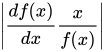
If a transcendental function (due east.g., the exponential role, the logarithm, and the trigonometric functions) is differentiable at its domain chemical element x, then its number of significant figures (denoted as "pregnant figures of ") is approximately related with the number of significant figures in 10 (denoted as "significant figures of 10") by the formula

,

where is the condition number. Run across the significance arithmetic article to detect its derivation.
Circular merely on the concluding calculation event [edit]
When performing multiple stage calculations, exercise not round intermediate stage calculation results; go on every bit many digits equally is practical (at least i more digit than the rounding rule allows per stage) until the cease of all the calculations to avert cumulative rounding errors while tracking or recording the meaning figures in each intermediate event. Then, round the last effect, for example, to the fewest number of significant figures (for multiplication or sectionalization) or leftmost concluding significant digit position (for addition or subtraction) among the inputs in the last adding.[15]
- (2.3494 + ane.345) × 1.ii = 3.694four × ane.2 = 4.43328 ≈ 4.4.
- (two.3494 × 1.345) + ane.2 = 3.159943 + i.2 = four.three59943 ≈ four.4.
[edit]
When using a ruler, initially use the smallest mark as the first estimated digit. For example, if a ruler's smallest mark is 0.1 cm, and iv.5 cm is read, then it is 4.5 (±0.1 cm) or iv.4 cm to iv.6 cm as to the smallest mark interval. However, in practice a measurement tin normally be estimated by eye to closer than the interval between the ruler'southward smallest mark, e.g. in the higher up case it might be estimated as between 4.51 cm and iv.53 cm.
It is too possible that the overall length of a ruler may not be accurate to the degree of the smallest mark, and the marks may exist imperfectly spaced within each unit. However assuming a normal skillful quality ruler, it should be possible to estimate tenths between the nearest two marks to achieve an extra decimal identify of accuracy.[16] Failing to do this adds the error in reading the ruler to any error in the calibration of the ruler.[17]
Estimation in statistic [edit]
When estimating the proportion of individuals carrying some particular characteristic in a population, from a random sample of that population, the number of significant figures should not exceed the maximum precision allowed by that sample size.
Human relationship to accurateness and precision in measurement [edit]
Traditionally, in various technical fields, "accuracy" refers to the closeness of a given measurement to its true value; "precision" refers to the stability of that measurement when repeated many times. Hoping to reflect the manner in which the term "accuracy" is actually used in the scientific community, there is a recent standard, ISO 5725, which keeps the same definition of precision but defines the term "trueness" every bit the closeness of a given measurement to its true value and uses the term "accurateness" as the combination of trueness and precision. (See the accuracy and precision article for a total word.) In either case, the number of pregnant figures roughly corresponds to precision, not to accuracy or the newer concept of trueness.
In computing [edit]
Computer representations of floating-point numbers utilise a form of rounding to significant figures (while ordinarily not keeping runway of how many), in general with binary numbers. The number of correct significant figures is closely related to the notion of relative error (which has the reward of being a more than accurate measure out of precision, and is independent of the radix, also known every bit the base, of the number system used).
Run across also [edit]
- Benford's law (first-digit police force)
- Technology notation
- Error bar
- False precision
- IEEE 754 (IEEE floating-point standard)
- Interval arithmetic
- Kahan summation algorithm
- Precision (information science)
- Round-off error
References [edit]
- ^ "Significant Figures - Writing Numbers to Reverberate Precision". Chemistry - Libretexts. 2019-09-04.
{{cite web}}: CS1 maint: url-status (link) - ^ a b Lower, Stephen (2021-03-31). "Significant Figures and Rounding". Chemistry - LibreTexts.
{{cite spider web}}: CS1 maint: url-condition (link) - ^ Chemistry in the Community; Kendall-Hunt:Dubuque, IA 1988
- ^ Giving a precise definition for the number of correct significant digits is surprisingly subtle, see Higham, Nicholas (2002). Accuracy and Stability of Numerical Algorithms (PDF) (2nd ed.). SIAM. pp. iii–v.
- ^ Most accurate value of pi
- ^ a b "How Many Decimals of Pi Do Nosotros Really Need? - Edu News". NASA/JPL Edu . Retrieved 2021-10-25 .
- ^ "Resolutions of the 26th CGPM" (PDF). BIPM. 2018-11-xvi. Archived from the original (PDF) on 2018-eleven-19. Retrieved 2018-11-20 .
- ^ Myers, R. Thomas; Oldham, Keith B.; Tocci, Salvatore (2000). Chemistry . Austin, Texas: Holt Rinehart Winston. p. 59. ISBN0-03-052002-9.
- ^ Engelbrecht, Nancy; et al. (1990). "Rounding Decimal Numbers to a Designated Precision" (PDF). Washington, D.C.: U.Due south. Section of Education.
- ^ Numerical Mathematics and Calculating, by Cheney and Kincaid.
- ^ Luna, Eduardo. "Uncertainties and Significant Figures" (PDF). DeAnza College.
{{cite web}}: CS1 maint: url-status (link) - ^ "Meaning Figures". Purdue University - Department of Physics and Astronomy.
{{cite spider web}}: CS1 maint: url-status (link) - ^ "Significant Figure Rules". Penn State University.
- ^ "Incertitude in Measurement- Meaning Figures". Chemistry - LibreTexts. 2017-06-16.
{{cite web}}: CS1 maint: url-status (link) - ^ de Oliveira Sannibale, Virgínio (2001). "Measurements and Meaning Figures (Typhoon)" (PDF). Freshman Physics Laboratory. California Institute of Technology, Physics Mathematics And Astronomy Division. Archived from the original (PDF) on 2013-06-18.
- ^ Experimental Electrical Testing. Newark, NJ: Weston Electric Instruments Co. 1914. p. 9. Retrieved 2019-01-14 .
Experimental Electrical Testing..
- ^ "Measurements". slc.umd.umich.edu. University of Michigan. Retrieved 2017-07-03 .
External links [edit]
- Significant Figures Video by Khan academy
dalrympleyoungold.blogspot.com
Source: https://en.wikipedia.org/wiki/Significant_figures
0 Response to "what is 3 482 to two significant figures"
Post a Comment