Examine Class as a Whole to Inform Whole Group Instruction Classroom Clip Art
In The Magician of Oz, Dorothy and crew are so intimidated by the Magician's enigmatic personality that they struggle to talk with him on equal basis. Fear and frustration overwhelm them equally they blindly accept a suicide mission to slay the Witch of the Due west. In return, they each receive a treasured prize: a heart, a encephalon, courage, and a way home. Ironically, they already have these gifts—which they only detect after unveiling the homo behind the pall posing equally the grumpy magician.
Differentiated teaching (DI) casts a spell on educators as to how it meets all students' needs. The skill set required to differentiate seems mystical to some and incomprehensible to others in this environs of state standards and high-stakes tests. Where does one discover the time? The reality is that every instructor already has the tools to differentiate in powerful ways for all learners. I address some of these elements, such as assessment fog, in other Edutopia posts.
The DI elements were starting time introduced to me in How to Differentiate Instruction in Mixed-Ability Classrooms by Carol Tomlinson, and my understanding later deepened thanks to my friend and mentor Dr. Susan Allan. The cadre of differentiation is a human relationship betwixt teachers and students. The instructor's responsibility is connecting content, process, and production. Students respond to learning based on readiness, interests, and learning profile. In this post, nosotros'll explore the teacher's role for effective planning of DI, and in the next three posts, we'll await at how students respond.
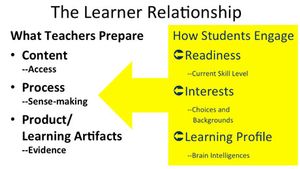
Paradigm Credit: John McCarthy
Content, process, and product are what teachers accost all the time during lesson planning and instruction. These are the areas where teachers have tremendous experience in everything from lesson planning to cess. In one case the curtain is removed for how these three areas can be differentiated, coming together students' diverse needs becomes obvious and piece of cake to do—because it's always been present.
Differentiating Content
Content comprises the cognition, concepts, and skills that students need to larn based on the curriculum. Differentiating content includes using diverse commitment formats such as video, readings, lectures, or audio. Content may be chunked, shared through graphic organizers, addressed through jigsaw groups, or used to provide unlike techniques for solving equations. Students may have opportunities to choose their content focus based on interests.
For example, in a lesson on fractions, students could:
- Watch an overview video from Khan Academy.
- Complete a Frayer Model for academic vocabulary, such as denominator and numerator.
- Watch and talk over a demonstration of fractions via cut a cake.
- Consume the block.
This example should reassure teachers that differentiation could occur in whole groups. If nosotros provide a variety of ways to explore the content outcomes, learners find different ways to connect.
Differentiating Process
Procedure is how students make sense of the content. They demand time to reflect on and digest the learning activities before moving on to the next segment of a lesson. Think of a workshop or course where, by the stop of the session, you felt filled to bursting with data, possibly fifty-fifty overwhelmed. Processing helps students assess what they do and don't understand. It's likewise a formative assessment opportunity for teachers to monitor students' progress.
For example, having one or two processing experiences for every 30 minutes of instruction alleviates feelings of content saturation. Reflection is a powerful skill that is adult during processing experiences. Some strategies include:
- Recall-Pair-Share
- Journaling
- Partner talk
- Save the Last Give-and-take (PDF)
- Literature Circles (which also support content differentiation)
Of these three DI elements, procedure experiences are least used. Showtime with whatsoever of the shared strategies, and come across long-term positive effects on learning.
Differentiating Production
Product differentiation is probably the most mutual form of differentiation.
- Teachers give choices where students pick from formats.
- Students advise their own designs.
Products may range in complexity to align to a respectful level for each educatee. (I discuss readiness in another mail service.) The key to production options is having clear academic criteria that students understand. When products are cleanly aligned to learning targets, student voice and choice flourish, while ensuring that significant content is addressed.
For example, i of my favorite practices is providing iii or four choices in products. All just the last pick are predeveloped for students who desire a complete picture of what needs to be washed. The last choice is open-ended, a blank check. Students craft a different product thought and advise information technology to the teacher. They have to show how their product option will address the academic criteria. The instructor may approve the proposal as is or inquire for revisions. If the proposal is too off-focus, the students piece of work on developing a new idea. If they can't come up with an approved proposal by a set due date, they take to choose from one of the predetermined products.
Achieve Higher
Content, process, and product are key elements in lesson design. Fortunately, educators have many instructional tools that can differentiate these core areas of instruction, such as these fifty+ social media tools, which gear up the phase for students to respond through the adjacent three DI elements in this serial:
- Learner readiness
- Learning profiles
- Learner interests
I do an activity where I ask participants to stand and reach as high as they tin. Then I inquire them to reach even higher. They do. When considering your students' needs, attain even higher in your practice—that extra stretch is inside us all—and students will benefit.
0 Response to "Examine Class as a Whole to Inform Whole Group Instruction Classroom Clip Art"
Post a Comment